Wednesday, 16 January 2013

Before the internet... Part 2


Not only were there advertisements on TV to inform us about what game to buy next, but there were TV shows about gaming. Be it either shows about a certain game such as the Super Mario Super Show, or a show that reads out reviews and challenges it's audience to games such as Games Master.

Let's start off with that one cartoon...

What is a "Pizanos" anyway? :/

The Super Mario Super Show appeared on TV in the UK just about as I got into the Mario games when I was 6 years old, and it got me pumped to know there was a cartoon on it. Now with the likes of Netflix and Youtube showing these episodes they're definitely in the class of "Yeah...  it's a Saturday Morning cartoon that seriously didn't age well". Plus with Charles Martinet as Nintendo's official voice for Mario, hearing Lou Albano (an ex WWF Wrestler who looks like he's taken more drugs than Randy Savage)  as Mario is just a little weird...


And hey, check this out! Mario Starring in a game show?!?   ...not quite, it's John Lenahan, who ever the hell he is...  After looking on Wikipedia he's some American magician who was semi-popular in the mid eighties...  Moving on... This was Super Mario Challenge, broadcast in 1991 on The Children's Channel. I remember seeing this game, and for whatever weird reason whenever a new season of this appeared, so did a new season of Super Mario Super Show would turn up...  Funny that huh? But again this is a weird moment in my childhood memory thinking this was cool, to find out this video decades later to discover that it use possibly the cheapest film set in human history by painting on car board boxes, then get people to play on air that honestly played Mario as if it was their first time playing it... You squandered my precious rose-tinted memories Lenahan!


Then came the Daddy of them all! Games Master! To me this was Epic Gaming TV viewing! Presented by Dominik Diamond and Sir Patrick Moore, it was just mind blowing to watch this as a kid in the early 90s. Dominik Diamond plays the role as the nerdy, yet dapper host, whilst Sir Patrick Moore has his face digitised onto a huge electronic CGI monument, where he becomes "The Games Master" with his posh, booming voice!


However in series 3 of Games Master, Dominik Diamond got replaced with the street wise Dexter Fletcher, however it just didn't feel the same, and ratings went really low. The fans demanded Dominik Diamond back, and he would be the host for all the future episodes.


The show lasted for 7 series', it's final episode was broadcast on the 3rd of February 1998. To be honest though, the intros for both series 6 and 7 had depictions of death and nightmares, and seeing the ageing Dominik Diamond turn from a young nerd into a 30 something beer guzzling lager lout wasn't a pretty sight, and it was pretty clear that he wasn't too into the whole television broadcasting thing. When he left Games Master he became a journalist for the *COUGH*porno*COUGH* Daily Star, but he soon took on being a radio host as a career, appearing in a few Scottish Radio Stations, and now he lives in Canada where he's a host on the Q104 Nova Scotia Radio Station.


After the popularity Of Games Master launch back in 1991, plenty of other shows ran with the same "Review and Challenge" format. One of which was Games World, Run by Bob Mills, and ex Games Master commentator and proud head band wearing silly man, Dave Perry, this Games Master clone was no where as good as what they tried to copy from, and ultimately lost my interest...


One of the "other shows" that did grab my interest was Children's ITVs Bad Influence. Hosted by Violet Berlin and Andy Crane, they made a more kid friendly video game TV show by using bright colours and animated dinosaur characters rather then the dank, dark, moody themes used in Games Master. It was more of a news and review show, it didn't feature any of the challenges as seen in Games Master or Games World, however Violet Berlin did get to host Head to Head...

Oh look! It's Guru Larry in his pre teen years! check out that mullet! lol!

Head to Head was a very short show (Never longer than ten minutes) that concentrated on a single challenge, the idea being that champion from the challenge before, would take on new challenger, and see if he can keep his place on the Head to Head show. I did see a few of these shows, but when I said above that Super Mario Challenge was the cheapest film set ever, maybe I was wrong, THIS has to be the cheapest! It was just a pair of TVs with chairs in the middle of a darken room! Personally I wouldn't send a kid to this show! The set itself sounds dodgy!


Out of all the the rubbish video game cartoons that came out. Sonic was cheesy, Zelda was even worse, Captain N looked like the eighties red headed step child. There was only one that was only mildly amusing in short bursts, and that was Earthworm Jim. Only because it was the only game cartoon I could think of that felt that the artists and the script writers had actually played the game! Mind you, it did receive the typical American Saturday morning cartoon affair where everything had to be cheery, bright, and kid friendly, when in the game, it was pretty dark, moody, and Jim's gun packed quite a punch, when he never used it in the cartoon. However there was a sense of that the company behind the cartoon had paid attention to the game and made sure that even with it's kid friendly censoring, they didn't do any silly crap like renaming characters, adding weird continuity that made no sense to the game, or inventing plot that makes no sense...  wait, remove that last one! The Earthworm Jim Cartoon was fairly faithful to it's game despite the fact they took the route or no guns aloud, when a gun was Jim's main weapon!


Later on in the late nineties and early two thousands, TV shows about video games pretty much disappeared, Games Master continued as a magazine that would eventually turn into some pretty bad reading material, there was a CGI Donkey Kong cartoon made by some French animation studio, and the Pokemon anime came in to tell the world that Japanese animation was going to rule. However, there were a few odd late night video game TV shows that I attempted to tape using my TV/VCR combo. One of which was called Cybernet, and another called Thumb Bandits. These were shows that were broadcast on Channel 4 at 1 or 2 am and were geared towards more adult viewers. But to be perfectly honest we were starting to get our gaming news from a thing called, "the Internet", so shows like these never really took on. Even Thumb Bandit's male host, Iain Lee, thought it was a terrible show!

In this modern age where Youtube is almost destroying TV, at least for our generation, maybe not so for generations older than us. There's more gaming video content online than what the mind could handle with shows such as the Angry Video Game Nerd, Classic Game Room, and the pretty recent Game Grumps, all make a new generation of Gaming video viewing all to the command of our finger tips...

However...  ...there is one more TV show...


What happens when you add cynical comedy, video games, and the BBC? You get Charlie Brooker's GamesWipe. Broadcast on BBC4, and aimed again towards Adults, but aired at a better time of 11 pm, Charlie Brooker's GamesWipe is the latest in television Gaming viewing where he take political views on gaming and smashes them with his sarcastic comedy, whilst delving in his own nerdy nostalgia of gaming gone by. Definitely worth watching if you can see it!

But, before I end this blog, I must give my respects to the late Games Master, Sir Patrick Moore...

4 March 1923 – 9 December 2012
Rest In Peace Games Master!

Tuesday, 15 January 2013

Before the internet... Part 1

Before there was the internet there was Television, and what television was good for back in the eighties and nineties was advertising and commercials. It was a time where if you weren't reading gaming magazines, you would find out about games through television Adverts. Here's a few I remember from back in the day...


This advert for Super Mario Bros 3 was just epic, as a kid I always wanted to know how they pulled off having so many people to make that mosiac of Mario across the United States...  Well it was all computer generated!


"To be this good takes Sega" was a set of adverts I really remember well with it's crazy mechanical and robotic themes with a dude living inside a huge American eighteen wheeler lorry. As much as I was a Nintendo Fan Boy at the time, they used to show these adverts a lot in the early nineties.


I got into reading gaming magazines when I saw a cover of Nintendo Magazine System with Super Mario Land 2 on the front of it, I had to have it! I needed to know what the next Mario game is like, and just as I saw this Magazine cover, this advert appeared on TV around the same time in winter of 1992. Just the crazy look on Wario's face in this advert made Wario Mario's next big enemy!


Sony's "Double Life" TV ad in 1998 is by far, the darkest, but powerful advert I've seen, that makes people know that as much as society has a habit of labelling gamers as antisocial individuals, we have witnessed a form of art they are not aware of...


"Up to 6 Billion Players" was the slogan Sega used for their adverts when the Dreamcast started to release Online games such as Chu-Chu Rocket, Phantasy Star Online and a bunch of Football and sports games.


With the internet age on our hands, at least I don't need adverts to tell me what game to get, websites, blogs, podcasts and game news and reviews can be seen on the web. However in Part 2 of "Before the Internet", I'll be blogging about TV shows about video games in the early nineties.

Monday, 14 January 2013

Why play a Zelda or a Final Fantasy game?

Today I got an interesting question from Vipp in the GameGavel/RetroGaming Roundup Forum...

I am listening to the Stalking The Retro Podcast and you were referring to RPG games again so I wanted to ask you a question. My Fiancée is determined that I am a fan of RPG games because I have 100% on Fallout 1 and 2 including both add-on packs also the same goes for the epic Skyrim, I love these games and play them (even past me 100 percent-ing them all) however I just can't play or be entertained by Zelda and Final Fantasy or games like these.

What exactly is the difference between these types of games? I really can't play Zelda and such titles even after trying to invest good time into them. Shinning Force on the Sega Mega Drive is the only title that I found the storyline to be good enough to keep me entertained long enough to fight a few battles but I had my ass handed to me by a set of flying goblins so my playing that title was short lived. Can you write a blog on this issue? Does everyone see Fallout style games in the same way they see the 'underwhelming' Final Fantasy Series and so on?

OK Mister Vipp, Challenge accepted!

You see, back in my Childhood days, all I would play are Mario games, and not a lot of anything else, ...well I did have some Simpsons and Teenage Mutant Hero Turtles games, but those were franchises that I had already known from TV. I knew about other Nintendo games from my Friends, magazines and what they showed on TV, but I wasn't hassling my parents to get those games, I wanted the all the Mario titles on my Game Boy and NES.

However, in my pre teen days, I started to have a curiosity about the other Nintendo Franchises. I was about 11, and I remember that I had saved up some money from my Birthday, and had kept it for a while, and back in these days, Mail order games were in the "in-thing", and I remember seeing an advert in the Nintendo Magazine System for a mail order service, and they had "Zelda: Link's Awakening" listed as one of the many GameBoy games they had, and I asked my Mother that if I gave her the money would she order it for me. So a cheque was sent in the post, and a week later I received my new game...

This was the version I got, the Nintendo Classics edition with it's trade mark red border.
For me, this was delving into something that had mystery and uncertain concisenesses as I hardly played a Zelda game before, however I was in for a treat!


The game begins with an introduction with Link being caught at sea in a storm, and a lightening bolt hits him followed with an awesome musical score that got me pumping within seconds of turning the game on.


The game is pretty much like any other Zelda game, you collect items and weapons, sometimes dungeons might possess items or weapons that will progress you in the dungeon. But there are two major factors that made this game different to the others. It was the first Zelda game on a portable, and it was the first Zelda game where Zelda herself is no where to be seen...  ...well there's a girl who looks like Zelda, but her name is Marin. Plus, it's the first Zelda game not to take place in Hyrule, the kingdom that Zelda games are typically based in. In The Legend of Zelda: Link's Awakening, you find yourself on a deserted land called Kohlint Island with a great big giant egg perched on the top of a mountain.


What I enjoyed about the playing a Zelda Game for the first time was the great amount of puzzle, action, and exploration in the game. Before I even played a Zelda game, I did get a chance to play a Final Fantasy game, Mystic Quest on the SNES. Having now played a Zelda and a Final Fantasy game, I really had an appreciation for the Zelda franchise as I didn't like the turn based battle system in Final Fantasy Mystic Quest. I preferred being able to swing my sword instantly with a press of a button rather than stacking up a list of commands in a Final Fantasy. It felt like I was being Link, rather than being a person commanding battle tactics in Final Fantasy, I was the personally the protagonist, it's story made you felt like you are Link and that your actions were your actions rather than just a sprite on a screen.

It took me a while before I started to enjoy a turn based battle system...
With the Final Fantasy games, it took me a while to really enjoy these kind of games, as I preferred the Zelda games more real time action approach to gameplay. The way I began to appreciate the Final Fantasy games was their stories and the on going progression that you make in the game as you slowly become stronger and stronger in the game. Sure it can feel like a choir, grinding to level up, but it has a simple life message behind it, working hard provides great results, and that's what Final Fantasy and other turn based role playing games do.

After playing Mystic Quest, I had a chance to play a bit of Final Fantasy: Legend II on the GameBoy.


In the UK and Europe, the NES Final Fantasy games were not available, and the only Final Fantasy game we got on the SNES was Mystic Quest. However we did get the GameBoy games. I didn't get to own these games until I started to get a job and get paid, but I used to baby sit a kid who owned Final Fantasy Legend II, and I would play it when he went to bed. This game is meant to be the better of the Final Fantasy Legend games, however I discovered later on that these Final Fantasy games aren't based in the Final Fantasy Lore, rather they're actually a different game all together as it's called the SaGa Series in Japan. So Technically the only "Real" Final Fantasy game us Brits could play was Mystic Quest.

However...


...we did receive Final Fantasy VII on the PlayStation!

I first played this game when I was in my Teens, just before it's sequel, Final Fantasy VIII, was about to come out. At first I didn't care too much about the game, but it was really a case of playing the game that got me into this.


Now granted... Final Fantasy VII is the most overrated and over-spoken version of the game, but it was the game that actually got me into the series, and finally made me like the turn based battle system. Not only that, but it was the first turn based role playing game whereby it had the Active Battle System in it. ABS was actually introduced in Final Fantasy IV, but us Brits didn't get a chance to purchase this game. It was released in the US under the name Final Fantasy II, as the US missed Final Fantasy II and III on the NES, which would cause a huge continuity error in the future. But keeping to the subject, the ABS made turn based battling much more interesting as it kept a flow in combat that made it faster and more frantic than before, forcing you to make good decisions at quick speeds, because there's a chance for the enemies to take two turns as you're trying to make a decision on what kind of attack to make next.


Not only did the Active Battle System make turn based fighting batter, but Final Fantasy VII had a lot of world map exploration, that reminded me a lot of the Zelda series. But the biggest thing I liked about Final Fantasy VII is it's bang to the buck! When I got this game in my possession, I actually got the PC version of it, I managed to clock about 60 hours into it until I beat the game. I don't think I ever played a game for that amount of time before, proving that the game had A LOT to do in it. If it was breeding Gold Chocobos so that you can get the best Summon-able creature, looking for better weapons, working out combining magic to get the best results. It got you in and playing it for hours and hours. It's a shame that these days I don't play a single game for that amount of time.

But before I end this blog, I'll write up a little about the main differences between the two games...

Continuity and Story

As the Legend of Zelda games always play the role of Link, Link himself might actually be of a different generation than the one in previous games, there can be hundreds of years between Zelda games, but the characters will appear again and again, as if there are many comings of these characters. The series itself has a little bit of a continuity issue, as games after Zelda 2: Link's Adventure, never have a number, and made it hard to know where to put the games in a time line. In the book, Hyrule Historia, the Zelda time line was finally announced after many people and sites had their own ideas on what order the Zelda games come in. Before Hyrule Historia, people believed in something called "The Split time line", where the time line would split into two lines after Ocarina of Time, and then different games would appear in each time line. However Hyrule Historia describes that there's actually three splits after the Ocarina of time. It's a little tough to explain this to someone who's barely played a Zelda game before, but it's worth playing them to understand how all the games are connected to each other.

In Final Fantasy, the continuity between games is hard because each game has a different story and world based on it. However some themes, characters and monsters are shared between them. Between Final Fantasy VI and IX there has been a pair of guards called Biggs and Wedge, these names were taken from the pilots in the Original Star Wars Trilogy. From the Japanese Final Fantasy II, a character called Cid, often seen as a captain piloting an air ship, has been seen in every Final Fantasy game since, but he's been portrayed in different ways, such as age, attitude, and alignment, being either, good, bad or neutral.

Combat

As mentioned above, the Zelda and the Final Fantasy games have very different forms of combat, however combat does change and evolve in each successor. For example, the SNES "Link to the Past", Link now has a curved swing on his sword rather than his basic thrust seen in the NES game. This is so that you can attack enemies coming at you from your diagonals. In the latest Zelda game, Skyward Sword, the Wii Motion Plus is used to achieve one-to-one sword combat that works very well, and introduces gameplay mechanics such as which way do you swing your sword to certain enemies and understanding attack patterns. 

In Final Fantasy, the ABS system was kept from Final Fantasy IV to Final Fantasy IX. In Final Fantasy X, they got rid of ABS, and went more for a traditional look on turn based combat like the first three Final Fantasy games on the NES/Famicom. However there's a list on the upper right hand corner of the screen showing you a list of who's turn is coming up, and this list might change due to different commands you make, they might take longer for you, or might cause the enemy to miss a turn, you could see this happen in the list. Final Fantasy XII had something called the Gambit System, where each Gambit you collected in the game aloud you to "program" the other characters in the game. In Final Fantasy XII, you had no direct control on other allies, however you would "program" them using these Gambits that gave them commands that would be performed under certain conditions. For example you can have "When Leader attacks an Enemy, then <this character> attacks Enemy", where there's a verb or noun in that command, you have a Gambit, and they would build up different commands you can build for other allies in the game.


So there you have it, there's Zelda and Final Fantasy in a nutshell...  Sort of...

Vipp being a Shining Force and Fallout fan, I need to keep up with other Role Playing games myself. I did enjoy Fallout 3 a lot, though Fallout 1, 2, and Tactics are different games compared to 3. I actually own the original Fallout games, so I better try and get into them, I've only played about thirty minutes of Fallout 1 and 2, so I better give myself more time to play these classics in Vipp's eyes. Plus I need to get into the Shining series too. I possess Shining in the Darkness and Shining Force, on the Mega Drive, PC and XBox 360 through the Ultimate Mega Drive Collection. I really should get myself to play those too!


I better start questing!

Update!

Whoops, I post this blog up and forgetting something! What games I should recommend to Vipp and other Zelda and Final Fantasy Virgins out there!

In the Zelda Series I would recommend Link's Awakening, Ocarina of Time, and Skyward sword as good for newbies to get into the series.

I pick Link's Awakening as it's my introduction to the series, Ocarina of Time as it's the most popular in the series, and Skyward Sword as it's now the earliest game in the series' history, not only that but uses motion control very well, possibly the best motion control in any game.

In the Final Fantasy Series I would recommend Mystic Quest, Final Fantasy VI, Final Fantasy VII, and Final Fantasy XIII.


I pick Mystic Quest, because it's the best for Turn base combat newbies, as Mystic quest is an Entry level Role Playing game, good to learn turn based mechanics and rules. Final Fantasy VI as it's my favourite Final Fantasy game with the best story in the series. Final Fantasy VII as it was the game that got me into Final Fantasy, it simplifies a lot of things such as not restricting magic to certain classes and characters, meaning any character could do almost everything, it was only the weapons and armour that was restricted. And I finally pick Final Fantasy XIII as it has a very different kind of battle system where you actively switch between different formations to achieve different results such as all out assault, healing, or a mixture of the two. A lot of people shit on the game for being too linear, but I actually liked the game, sure it's not as good as VI, but it's still a descent game in my opinion.

Saturday, 12 January 2013

Alarm clock games!?

I have a hard time trying to get out of bed, it seems that no matter how much sleep I have, I either under, or over sleep, feeling like crap, and wanting more precious time for beddy bye byes... Well here's a crazy concept, what if you turned waking up into a social game!?


Say hello to Wake Up Club. A free game making its way on the PlayStation Vita on the 15th of January.


The game is pretty simple, it encourages you to get out of bed rather than hitting snooze by comparing your ability to get out of bed with your friends and people over the Internet.


The game play is rather simple. As the alarm goes off, the PlayStation Vita screen unlocks and turns on. Your PlayStation Network avatar will bounce across the screen, and in order to turn the alarm off, you have to touch your moving avatar on the touch screen. However, if you continue to sleep, avatars of your friends and other players who have been successful in tapping their avatar will appear in your game and make more noise with the existing alarm. To get rid of noisy friend avatar you have to touch and swipe them off the screen, and you can only move one at a time. After clearing the screen you're joined with friends and others who wake up at around the same time as your avatar invades the sleep time of other snoozing gamers.

Personally I think this is an AWESOME idea for a social game! Thing is, way PlayStation Vita? Well it's a first party Sony developed game, so of course it's going to be a Sony console exclusive. However...  I have found an alarm clock game for Android devices...


Here's Brain-A-Wake!

The game isn't as socially involved as Wake Up Club, but what Brain-A-Wake does is mix an Alarm clock with Brain Age.


When the alarm on your Android device goes off. It challenges you to a set of Brain Age like games where the player has to solve to turn the alarm off. But the idea behind this is that by the time you answered the questions right, your brain is awake because you had to force yourself to become alert to answer them. It sounds like a really cool idea, shame it's presentation isn't as flashy as the PlayStation Vita's Wake Up Club. But it is earning high scores from users, so it might very well be a descent alarm clock game under some sub par presentation...

That's not all though, there are alarm clocks out there with games built into them whereby to turn the alarm off, you have to play the game! This one for example is an alarm clock that been built using an Arduino kit that plays Tetris on it, but it's aware of if you try to sleep again. A very cool home made alarm clock!


And somewhere out there on the internet you can actually purchase a Dance Machine alarm clock where you have to play a game of rhythmic simon to turn off a really loud 70s disco music.

As much as I liked Dance Dance Revolution back in the day, I'm not getting one of these! lol!

Friday, 11 January 2013

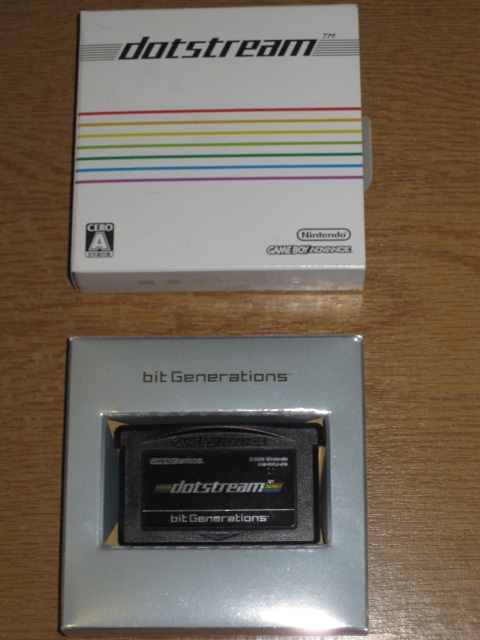
Unique Games: Dot Stream


In the final days of the GameBoy Advance in 2006, a collection of contemporary games were released in Japan called the Bit Generations Series. It was a set of seven games sold individually at a budget price, are were packaged in a unique box that were smaller than the standard Japanese GBA game boxes. Out of the seven games, one really stands out, it's called Dotstream; if you're a retro game fan, you'll easily notice how it has a similarity to the likes of the Tron light cycles, or Intellivision's Snafu, but this game is different, it's actually a racing game!


So, how does a game like Tron and Snafu become a racing game? Well, I'll tell you. The idea of Dot Stream is that you play as a coloured dot that constantly moves forwards and can shift up and down to change lanes. You don't actually control the acceleration of your dot using the buttons, to get faster you have to get close to the colour line that's in first place to increase your dot's speed. No dot can have the same space, it's hard to describe, but there's lanes, you just don't see them in the pictures, but when you play the game you'll know what I mean by this. Unlike Tron or Snafu, Dots and lines can cross, but as mentioned before, a dot can't be in the same "lane" that's been occupied by another line, your dot just gets automatically moved to the next nearest "lane". As you climb your way up to first place, you have to take advantage of zippers, avoid obstacles and pay attention to any dots that are speeding up behind you from your trail. You have 3 lives in each race, or "Drawing" as it's called in this game, as your dot draws a line of course, if you lose all 3 lives in a track, you forfeit your chance to earn any points in the Grand Prix.


In later levels you can pick up items in similar vein to Super Mario Kart, you pick them up and can activate them using the A button. There are three items, a Star, a playback symbol, and a diamond. The Star when activated will darken the playfield that makes a higher chance of you opponent racers to crash into walls and obstacles. Activating the playback symbol causes the screen to go inverted and pauses your fellow racers as you continue to move for an extra 3 seconds to reach first place. The Diamond adds a booster shown in the bottom left hand corner of the screen, these boosters can then be used by pressing the R Button, they act just like the mushroom in Mario Kart.

The Dotted area shown here will slow you down if you touch it
You must avoid these obstacles, or you will lose a life

There are a total of 5 Grand Prix's. When you come first in any of the Grand Prix's, you unlock a "Formation" game. This isn't so much of a racing game, but more of an "Avoid-em-up". The first Formation game you unlock is where you collect pink orbs to increase a power bar at the bottom of the screen and avoid any in coming obstacles. The power bar is made up of squares, and filling up a square will earn you a new dot and line. This is where it gets tricky because you'll be game over if the new dot hits an obstacle. You can control the new line by holding the A button and pressing up and down on the Dpad, however the first dot will move too. So it turns into a a juggling act as you try to manage to pick up more orbs to collect new dots, but try not to hit anything at the same time either. It gets very tough once you get 4 dots on the screen at once!


Dot Stream on the GBA didn't get a Western release, nor did the other Bit Generation games, although there was a trademark made by Nintendo of America called "Digiluxe" that was rumoured to be the Western version of the Bit Generations games. However with the demise of the GBA, the Bit Generation series did get it's way onto the DSi and the Wii with the "Art Style" name. In-fact Dot Stream got it's own "Art Style" game called "Light Trax" on WiiWare. Light Trax pretty much is the sequel to the GBA Dot Stream game, and incorporates different directions, 3D camera angles, and a "Cruise" mode whereby you "drive" your dot on a highway, and drive through exits to unlock new Grand Prix's.


That's not all though, there are clones of Dot Stream on Xbox Indie games, there's Stream Line (Above) and Bit Stream (Below). These two games play A LOT like Dot Stream and Light Trax.


Nintendo Power-esque TIP!
There's a pit stop in each level of the game, stop at one and you'll receive 9 boosts! Just be aware that you'll be stopped until you fill up with all 9 boosts.

Thursday, 10 January 2013

For the Love of Galaga!

I'll admit, I do love a good shooting game, and by shooting game I don't mean First person shooter! I mean a “sh'mup”, a genre where you're likely to control a space ship and you shoot things with lasers. Oh yeah... Now, I had experience with Space Invaders, as I had it on a Arcade compilation on a tape for the Commodore 64. Later on in my 16-bit days I played a lot of Super RType on my friend's SNES, a little later on I found a love for Gradius on a Famiclone that my cousin once got for Christmas. Then there's Ikaruga on the Gamecube and so on... But there's one “Sh'mup” that really gets the love from me.


My love for Galaga started when I was about eleven or twelve years old in the mid 90s when I went on holiday with my Mother to Hunstanton. Rather than doing the typical Searles Holiday Camp vacation. We stayed at a rather nice little Bed and Breakfast with an indoor swimming pool inside! Mind you the indoor swimming pool was the size of two large hot tubs, but it was still impressive that they crammed a swimming pool in a small Bed & Breakfast. But as I walked into the Bed & Breakfast, I saw an arcade machine that was turned off, it was still attached to the wall socket, but it was switched off; I walk up to it, flicked the switch on the wall socket, and saw a game boot it, it was Galaxian, and what was better, it was set to free play!


I loved the game, it was simply an evolution to Space Invaders that I would play on my Commodore 64. The aliens would swoop down and try to kill you by either shooting lasers at you or crashing into you. Plus the ship actually displays when a laser is ready to shoot as you can see the readied laser as a yellow line on the top on your space ship.

Now, I can't remember when or how I feel in love with Galaxian's sequel, Galaga, but from what I remember, it was a compilation pack, so possibly Namco Museum, or another Namco collection, but at tghe time I was hunting for Galaxian, but I couldn't find it, but I found Galaga, and I was telling myself "I don't want Galaga, I want Galaxian!". But I played Galaga anyway, and then said to myself "Hell yeah! This is actually better!". What made this better than it's predecessor, were the new ways the enemies would swoop down to attack, and the enemy could steal your spaceship and lose a life. 


But that's where the game gets interesting, because you can claim the ship back and join the two Spaceships together to get...


Double Ship! Hell yeah!!!!!

Once you get yourself the double ship, you are able to shot two lasers at once, which is essential to perfecting the game's Bonus levels and clearing levels quicker. This gameplay mechanic itself I believe was what started the idea of "Power ups make you take more hits". Without this Gameplay mechanic, Mario might lose a life on a single hit, and no mushrooms to make him bigger to take a hit before loosing a life. This for sure is an evolution not just to Sh'mups, but to gaming itself.

So here's a Salute to you Galaga!

Before I end this though, let me go over a few sequels to Galaxian/Galaga series...

Galaga '88/'90


Pretty much a remake of the Original Galaga, made in Japan in 1988, and the US in 1990. Pretty much it adds new gameplay mechanics such as exploding enemies, where it's blast radius can kill other enemies and there's an item you can collect where you can skip levels or find new levels not seen in a typical play-through. There's a TurboGrafx version of this game that is really good, and it's worth getting if you have one, otherwise it's available on the Wii Virtual Console for 600 Nintendo Points.

Galaxian 3

Galaxian 3

Galaxian 3 is a behemoth of a machine it's the size of a couple of office cubicles put together and supports 6 players in their own chair. There's a huge screen inside, and each player controls a coloured cross-hair where you play a "one rails" shooting game where the SpaceShip would move by itself and each player plays as the guns. I've never played this, but I have seen one in the wild when I was about 10 years old and I was outside of Disney Land Paris, and one of these were outside an arcade with a gyroscopic After Burner near the door. I honestly can't imagine how much it would cost to play one of these, or even how much the arcade paid for it. But being close to Disney Land Paris, I can only imagine they did make money from it with all the kids visiting the theme park!

GaPlus/Galaga3

Gaplus - Title screen image

A bit of an oddity this one, this is Galaga game that aloud you to move in 8 directions rather than the traditional 2 directions. The game has graphics that share from both Galaga, and Galaga '90. The new gameplay mechanic in this game was that there's a weapon you can collect that allows you to abduct the aliens, rather than the aliens abducting you, and with your new alien buddies, they would act as this games double ship, however you can collect up to six aliens, meaning you had the chance to shoot a whopping seven lasers at once! However you have a bigger chance of being hit as movement becomes limited. Some Arcade cabinets in the US replaces it's "GaPlus" name for "Galaga 3". You can download this onto the Wii for 500 Nintendo Points (600 Points in  the US) from the Wii Shop Channel.

Galaga Legions/LegionsDX


The Latest in the Galaga series, released on the 360 Market Place, and the PlayStation Network Store. Galaga Legion is a bit of a black sheep, as it doesn't really follow the original Galaga gameplay mechanics too well. Rather it's more akin to GaPlus, but includes the ability to place satellite guns on the play field in one of four directions, up, down, left and right with the right analogue stick. These will auto fire until you press the bumper buttons to bring them back to the ship. Typically a legion of aliens will have one big alien, and shooting the big alien will cause the smaller aliens with it to die with the bigger alien. In similar vein to GaPlus, a black hole can be collected to suck up aliens, and use them as extra fire power against the alien hordes. Galaga Legions DX was released a year after, and plays a bit more like a twin shooter such as Robotron 2084 and Geometry Wars.

Wednesday, 9 January 2013

Steam Consoles!?

So...  If you're not aware, I'm a co-host on the Stalking the Retro Podcast, and on episode 22 we talked about Steam's "Big Picture" and how I believed that Valve is making a console. One: because the "Big Picture" is controller friendly, and Two: Valve possess patents towards a unique Valve branded controller with interchangeable sticks and buttons.

Well... CES is here, and even a day or two before CES, there's now more than one piece of kit that can get your Steam games on you TV without the need of building a Mini ITX PC.

First is the NVidia Shield.

Sorry NVidia, this is fugly...

And then there's the Xi3's Piston.

Valve Steam Box Piston
I swear there's more ports on the back of this thing than my desktop PC! :o

In short, the Piston is more of a PC crammed into a tiny box, more of an actual Steam Console, that's really just a tiny gaming PC, and the NVidia Shield in essence is an XBox 360 controller sized portable with a flip up screen that runs android and features a Shield exclusive software that can stream the video from a PC running Steam and play PC games on the Shield's screen, or output it to a TV via an HDMI output.


Seriously though, seeing pictures of the Xi3 Piston, and it looks awesome! I'm amazed how they crammed so much in it. And of course it's built out of more than one board that builds up a complete motherboard with more than on board and shaped into a small cube. If this was a Mini ITX PC, it'll be made of a Motherboard, a graphics card and a PSU, which would be A LOT bigger than this. Plus I would like to know what kind of graphics chips they use in this thing. The only downside of this little machine is that it's price tag is estimated to be a whopping $999! Now, building your own Mini ITX gaming PC would be cheaper than this. However Xi3 have stated that they're going to make the system upgradable and that you can take it apart and replace it's 3 boards that come with more RAM and faster processors. But with it's $999 price tag on it, yeah... I'll leave this for people with more money thank you very much!


The NVidia Shield on the other hand is pretty much an Ouya crammed into a 360-like controller with a flip up screen, and features video streaming from PCs that have Steam running on them.

NVIDIA Project Shield Hands On: A Little Less Weird Than It Looks

So it's a two-in-one deal here, it's a Tegra enabled Android tablet, so you can play your existing Android games on this, but with real buttons. Plus it has the function to stream Steam games onto either it's 5 inch screen or out from it's Micro HDMI output to a TV screen. There's no price estimated for this, but I can't see this costing the same price as the $999 Piston. I just hope they can change the design of it to make it look a bit more sleeker, I bet the designer was a huge fan of the original XBox!